


Intercom & communication systems are building-level platforms that combine visitor communication, identity verification, and controlled door release within a single, managed system. They connect entrance panels with occupants, reception points, or mobile users through audio and video communication, while door controllers and management software ensure secure and consistent access workflows.
In residential and commercial buildings, intercom systems are used to standardize how visitors are received, verified, and granted access. Unlike standalone doorbells or legacy analogue door phones, modern intercom platforms operate as part of the building’s technical infrastructure and support centralized administration, mobile answering, and system integration.
Depending on project requirements and existing infrastructure, intercom systems may be deployed using IP-based networks, two-wire cabling, or hybrid architectures. This flexibility allows system designers to balance installation complexity, scalability, and long-term operational needs across new developments, occupied buildings, and retrofit projects.
This guide reflects real-world intercom deployments across residential, commercial, and mixed-use buildings in Europe. Intertec supports system integrators and installers during system selection, design, installation, and commissioning—taking into account building typology, wiring constraints, lifecycle maintenance, and integration with access control and building management systems.
On this page you’ll find a practical, project-oriented overview of intercom system architectures, core components, and common use cases, along with professional intercom solutions selected to illustrate how these systems are applied in real projects.
Intertec is a European provider of professional intercom, communication, and access control solutions for residential and commercial buildings. The guidance on this page is based on hands-on project experience gained through system design, deployment, and commissioning across real-world installations.
Intertec works with system integrators, installers, and developers during intercom system selection and planning, helping align technical architecture with building typology, wiring constraints, project scale, and long-term operational requirements. This practical perspective ensures that the recommendations focus on reliable system design and lifecycle performance rather than theoretical feature lists.
An intercom system is a building communication solution that enables audio or video communication between visitors at an entrance and occupants inside a building. Modern intercom systems go beyond basic voice communication by supporting video verification, mobile answering, remote door release, and centralized system management.
At its core, an intercom system consists of entrance panels, indoor monitors or mobile applications, door controllers, and management software. Depending on the system architecture, intercom platforms can operate locally within a building or be managed remotely through cloud-based services.
Intercom and communication systems are used to manage visitor entry and communication in residential and commercial buildings by centralizing audio or video interaction and door control. This helps building operators improve security, reduce operational overhead, and respond more efficiently to visitor requests.
Intercom systems and access control systems are closely related but serve different primary functions within a building security architecture. Intercom systems focus on visitor communication and identity verification, enabling occupants or staff to see, hear, and interact with visitors before granting access.
Access control systems, by contrast, manage who is authorized to enter a building or specific areas, typically using credentials such as cards, mobile keys, PIN codes, or biometric identifiers. While access control governs permanent or recurring access rights, intercom systems manage real-time visitor interaction and decision-based entry.
In professional installations, intercom platforms are often integrated with access control systems to create a unified workflow that combines visitor communication with credential-based access management. A detailed overview of access control architectures and use cases is available in the Access Control Systems for Commercial and Residential Buildings guide.
Unlike consumer doorbells, intercom systems are designed as part of a building’s permanent communication and security infrastructure. Doorbells typically provide a simple call function, while intercom systems support two-way audio or video communication, centralized management, and integration with door controllers and access control systems.
Intercom platforms are used in multi-tenant residential buildings, offices, and mixed-use developments where structured visitor handling, scalability, and system reliability are required. Doorbells are generally suitable for single-family homes or small-scale installations without centralized access management.
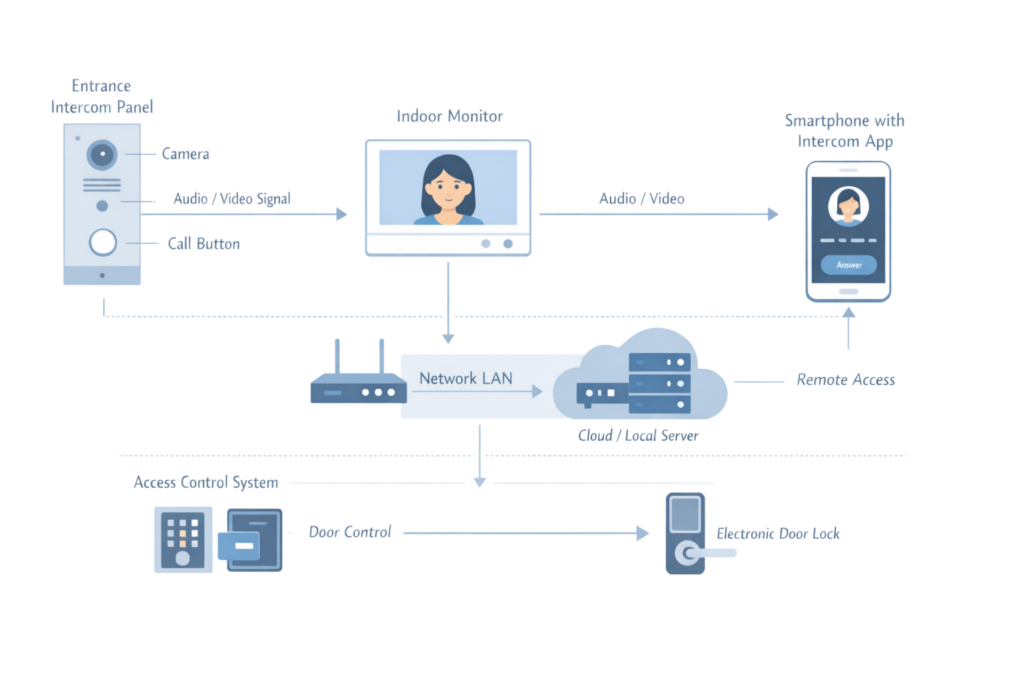
Intercom system architecture is typically defined during early project planning, where building layout, wiring availability, occupancy type, and future expansion must be evaluated together. Based on real project deployments, most intercom installations follow one of three architectural models: IP-based systems, two-wire systems, or hybrid intercom architectures.
Each approach addresses different technical and operational constraints and directly affects installation complexity, scalability, and long-term system flexibility.
Intercom systems can be implemented using different architectures depending on building infrastructure, wiring availability, and operational requirements. The most common approaches include IP-based, two-wire, and hybrid intercom systems.
IP-based intercom systems use standard IP networks to transmit audio, video, and control signals between system components. These systems are typically managed through centralized software platforms and can support remote access and mobile applications.
Example platform: Fermax MEET ME — an IP-based video intercom system designed for modern residential and commercial buildings.
IP-based intercom is typically selected when:
Key trade-off: IP-based systems rely on network infrastructure and proper network design, so bandwidth, security, and segmentation must be considered early.
IP intercom systems are well suited for modern residential developments, commercial offices, and mixed-use buildings where flexibility, integration, and future expansion are key project drivers.
Two-wire intercom systems operate over existing two-wire cabling, allowing audio, video, and control signals to be transmitted without replacing legacy wiring. These systems are designed to simplify upgrades and reduce installation complexity.
Example platform: Fermax DUOX Plus two-wire video intercom system for residential modernization projects.
Two-wire intercom is typically selected when:
Key trade-off: two-wire systems may have limitations compared to full IP architectures in terms of network flexibility and advanced integrations.
Two-wire intercom platforms are commonly used in apartment buildings, residential retrofits, and occupied properties where maintaining existing cabling significantly reduces project scope and cost.
Hybrid intercom systems combine elements of IP-based and two-wire architectures. Core communication may operate locally over existing wiring, while management interfaces, mobile access, or integrations are delivered via IP or cloud services.
Example platform: COMMAX intercom systems supporting IP and multi-wire deployment models for phased modernization projects.
Hybrid intercom systems are typically selected when:
Key trade-off: hybrid systems require clear architectural planning to define which functions operate locally and which rely on network or cloud services.
Hybrid solutions are suitable for complex projects that need flexibility over time, phased modernization, or a balance between legacy infrastructure and modern features.
In practice, the choice between IP-based and two-wire intercom systems has a direct impact on installation effort, upgrade potential, and long-term operating costs. The comparison below reflects typical trade-offs observed in residential and commercial intercom projects, where infrastructure limitations and operational requirements must be balanced.
| Comparison Criteria | IP-Based Intercom | Two-Wire Intercom |
|---|---|---|
| Wiring requirements | Ethernet / IP network | Existing two-wire cabling |
| Installation complexity | Higher in retrofits | Minimal in upgrades |
| Video quality | High-definition | Optimized for legacy wiring |
| Remote/mobile access | Native support | Limited or optional |
| Scalability | High | Moderate |
| Typical use cases | New buildings, offices, mixed-use projects | Residential retrofits, occupied buildings |
| Internet dependency | Internet required for remote access and cloud services | Limited or optional |
In summary: IP-based intercom systems prioritize scalability and integration, while two-wire systems prioritize simplicity and cost-effective upgrades. Hybrid architectures balance both approaches in phased or mixed-infrastructure projects.
Quick rule of thumb: Choose IP-based intercom systems for new buildings and projects where scalability, mobile access, and system integration are priorities. Choose two-wire intercom systems when upgrading existing buildings where rewiring is impractical or cost-prohibitive. Hybrid intercom architectures are best suited for phased upgrades and mixed infrastructure environments.
A professional intercom system typically consists of several core components that work together to manage visitor communication, identity verification, and door access.
Installed at building entrances, entrance panels provide audio and video communication with visitors and allow them to call occupants or reception points.
Indoor monitors or mobile apps allow occupants to answer calls, view visitors, and release doors. Mobile applications enable answering calls remotely.
Door controllers process commands from intercom devices and trigger door unlocking mechanisms according to system configuration.
In integrated security systems, intercom platforms often share door controllers, credentials, or management interfaces with access control systems. This allows buildings to combine visitor communication with credential-based entry, creating a consistent and auditable access workflow across entrances, common areas, and restricted zones. For projects requiring centralized access policies, reporting, or multi-site management, intercom and access control systems are typically designed together during the planning phase. A detailed explanation of access control system components is available in the Access Control Systems Architecture and Components.
Management software allows administrators to configure users, apartments, call routing, devices, and permissions. Depending on the system, software may be hosted locally or in the cloud.
Reliable power and communication infrastructure is essential for stable operation, whether using IP networks or two-wire cabling.
Intercom and communication systems are deployed across a wide range of building types.
Used to manage visitor entry, resident communication, and shared access points in apartment buildings and gated communities.
Enable secure visitor entry, reception workflows, and integration with access control systems.
Support flexible communication models across residential, commercial, and shared spaces.
Allow legacy intercom systems to be upgraded without extensive rewiring.
Early planning of user groups, call routing, and integration requirements helps ensure the system fits operational realities.
Intercom solutions are selected based on the system architecture, building type, and operational requirements defined earlier on this page. In practice, IP-based platforms are chosen for projects that require scalability, mobile access, and system integrations, while two-wire solutions are typically used for cost-effective upgrades of existing residential buildings. Hybrid solutions are applied in projects that require phased modernization or mixed infrastructure environments.
Intercom solutions are designed to support different system architectures and project requirements. The solutions below represent professional platforms commonly used in residential and commercial installations.
Below are professional intercom platforms commonly used in residential and commercial projects across Europe. Each solution supports a specific system architecture and is selected based on building type, wiring constraints, and operational requirements.
IP-based intercom solutions provide centralized management of entrances, users, and communication workflows over IP networks. They are typically selected for projects that require scalability, mobile access, and integration with access control and building management systems.
Two-wire intercom solutions provide a practical upgrade path for existing buildings by reusing legacy wiring while delivering modern audio and video communication features.

IP-based intercom system designed for modern residential and commercial buildings. Supports high-definition video communication, mobile answering, and centralized system management across single or multi-site deployments at scale reliably.

Two-wire intercom system designed for cost-effective upgrades and modernization of existing residential buildings. Delivers reliable audio and video communication using existing wiring infrastructure, minimizing installation time and disruption.

COMMAX intercom solutions support IP-based and 4-wire communication architectures for residential and multi-apartment buildings. The platform enables structured entrance communication, scalable deployment, and integration with access control systems across new and modernization projects.
Brand: COMMAX
Choose IP-based intercom systems for new buildings, projects requiring mobile access, and installations where scalability and integration are priorities. Choose two-wire intercom systems when upgrading existing buildings where rewiring is impractical. Hybrid architectures are best suited for phased upgrades and mixed infrastructure environments.
Selecting the appropriate intercom architecture early in the project helps avoid costly redesigns during installation and ensures compatibility with access control and building management systems. This is particularly important in multi-tenant residential buildings, commercial offices, and phased modernization projects where system flexibility and long-term maintainability are critical.
Intercom systems provide structured visitor communication and controlled entry across residential and commercial buildings. In practice, these systems combine entrance communication, identity verification, and door control within a single platform, and are deployed using IP-based, two-wire, or hybrid architectures depending on building infrastructure and operational requirements.
This intercom system overview is provided by Intertec, a European specialist in professional building communication and access control solutions. The content reflects practical system design and deployment experience across residential and commercial projects.
An intercom system is used to manage visitor communication and controlled entry in residential and commercial buildings. It enables audio or video interaction with visitors and allows authorized occupants or staff to unlock doors locally or remotely through a centralized set of interconnected devices, as described in the key components of an intercom system.
The main difference between IP-based and two-wire intercom systems lies in wiring requirements, scalability, and flexibility. IP-based systems operate over Ethernet networks and support mobile access and advanced integrations, while two-wire systems reuse existing cabling and are optimized for cost-effective upgrades. A detailed comparison is provided in the IP-based vs two-wire intercom systems section.
IP-based intercom systems operate over Ethernet networks, enabling high-definition video, centralized management, remote access, and integration with building IT infrastructure, making them suitable for scalable residential and multi-site developments, while 4-wire intercom systems rely on dedicated building cabling between entrance panels and indoor monitors, typically selected for residential upgrades where existing wiring is reused to reduce installation complexity and cost; in essence, IP systems prioritize scalability and network integration, whereas 4-wire systems focus on reliable building-level deployment with simplified infrastructure requirements.
Yes, many intercom systems can operate without internet access. Two-wire systems and locally managed IP intercom systems function within the building network, while internet connectivity is primarily required for remote access, mobile applications, and cloud-based management features, depending on the selected intercom system architecture.
Intercom systems integrate with access control systems by sharing door controllers, credentials, or management platforms. This integration allows visitor communication, identity verification, and credential-based access to operate as a unified workflow within the building security architecture. A detailed explanation of access control system components and architectures is available in the Access Control Systems guide.
Two-wire intercom systems are typically best suited for existing buildings. They reuse existing cabling, reduce installation complexity, and minimize disruption during upgrades, making them ideal for residential retrofit and modernization projects, as described in the intercom system types section.
Yes, intercom systems are widely used in commercial office buildings. IP-based intercom platforms are commonly selected for offices because they support scalable deployments, mobile answering, and integration with access control and building management systems, as outlined in the IP-based intercom systems overview.
In summary, intercom systems provide structured visitor communication and controlled entry across residential and commercial buildings. Selecting the appropriate architecture—IP-based, two-wire, or hybrid—depends on wiring constraints, scalability requirements, and long-term operational needs.
Intertec is a distributor of access control, intercom and identification systems for installers, system integrators and security professionals across Estonia, Latvia and the European market.